
Q&A Series: How nonprofit newsrooms serve communities of color
February 2022
How is nonprofit news meeting the needs of communities of color?
In this Q&A series, leaders from INN’s member news organizations address this central question. Responses range from creating new coverage areas, distribution channels, partnerships, fellowships, and above all, creating trust in communities served.
This Q&A series was facilitated by INN’s Sara Shahriari and Emily Roseman, with responses from various INN member newsrooms and editing by Rachel Kaminer.
Read more about this work in our post on INNsights.
Jump to:
Q&A with Ron Smith: How Milwaukee Neighborhood News Service builds cycles of trust
Q&A with Vandana Kumar: How India Currents engages audiences authentically
Q&A with Giles Morris and Sarad Davenport: How a newsroom partnership created a ripple effect
Q&A with Keri Mitchell: How Dallas Free Press uses text messages and community events
Q&A with Irene Romulo: How Cicero Independiente identifies community information needs
Q&A with Mareea Thomas: How WNIN shares people’s stories in their own words
Q&A with Ron Smith: How Milwaukee Neighborhood News Service builds cycles of trust
Who: Ron Smith, editor and project director
News outlet: Milwaukee Neighborhood News Service
Size of outlet as of January 2022: One permanent full-time employee
Outlet launch year: 2010
Tell us a bit about your news outlet. What sort of services does Milwaukee Neighborhood News Service (NNS) provide? What’s your outlet’s primary mission?
The Milwaukee Neighborhood News Service provides professional reporting to communities of color in Milwaukee that are primarily Black and Latinx. Our mission is to intentionally shine a spotlight on the ordinary people who do extraordinary things in our neighborhoods but whose accomplishments are seldom picked up by other media, which tend to focus on doom and gloom as well as drama and trauma. We are not a “good news” site, however. Our goal is to paint a complete portrait of life for central city residents.
Tell us about yourself! When did you start working at NNS? What does your role look like?
I am a lifelong journalist who started working while in high school for a nonprofit media outlet that produced a monthly paper written by and for Chicago teens. Since then, I have worked at places large and small, including Newsday, The Oregonian, the Los Angeles Times and the Milwaukee Journal Sentinel. I left my job as managing editor for news at USA TODAY to come to NNS in 2019. My job entails a lot more than I bargained for, including training students, working with our paid staff of six part-time reporters and editors, and supporting two Report for America corps members.
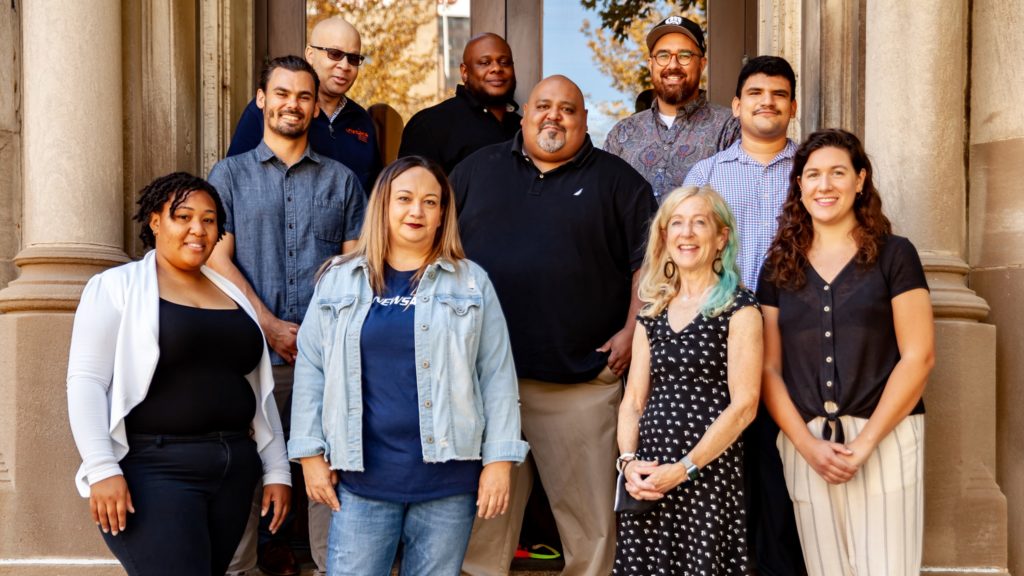
The NNS website includes a list of 18 neighborhoods you cover. Who does your outlet primarily serve, and how do you know this? Is your current audience different from who your outlet intends to serve?
Although we expressly tailor our coverage to Black and brown communities in Milwaukee, we have also attracted readers who live outside those neighborhoods who want to know more about life in the central city. We can see this by looking at the distribution list for our daily newsletter. In the beginning of the pandemic, we had 3,000 subscribers. Now, that list is 7,425. On Facebook, we have 17,937 followers. We can tell through our interactions that our audience is more diverse than we’d expected but more analysis is needed.
In an earlier conversation, you mentioned that a central part of NNS’ work serving communities of color is meeting your audience where they are. Could you tell me more about what you mean by that, and give an example of how this plays out in practice?
At NNS, we put a lot of thought into our newsgathering menu. There’s no sense in doing all this work if our audience is not being served. Milwaukee is one of many cities in the midst of an eviction crisis. While we continue to do stories that hold our elected officials and community leaders accountable, we know that this is not the most pressing concern for someone who is going through the eviction process. They are worried about staying in their home. We intentionally include resources where readers can get help to fill information gaps.
What challenges do you run into when you try to measure the impact and reach of this work?
The biggest challenge we run into is the lack of time and expertise to do thoughtful analysis. We know this needs to become a priority and will be working to get an audience growth strategist to help transform what we know anecdotally (or what we think we know) into something more quantitative. In many ways, we are still guessing about our readership, and we actually need to conduct a readership survey to help us assess who they are and also to help us gauge how to grow the audience.
“Ultimately the news business is about relationships. You can’t meet anyone where they are if they don’t trust you. And trust takes time to build.”
Ron smith
What’s a mistake you or the team have made while working to serve Black and brown residents of Milwaukee? How did this mistake change how you serve your audiences now?
I think we always make mistakes, but many have to do with our capacity. Until this year, we’ve not been able to reach our Spanish-speaking audiences, but through our partnership with the Wisconsin Center for Investigative Journalism, we’ve been able to hire a person to translate some of our stories. I always say we are a “community powered” newsroom but I don’t think our newsroom as a whole spends enough time in the communities and we need to be more intentional about that. In 2022, for example, we are devoting the fourth Thursday of the month to go out in the community and talk to neighborhood groups and agencies about what they are doing and the stories they think we should be covering. I feel this will help our efforts to cover the community and show residents that we don’t want to be transactional. Rather, we hope we can be transformational. You can’t listen to the community if you are not in the community or providing a safe place for leaders to interact with your newsroom.
What advice do you have for other news organizations who are hoping to shift to a mindset of meeting audiences where they are?
Take the plunge. And be willing to make mistakes, own your mistakes and share that with the community. Ultimately the news business is about relationships. You can’t meet anyone where they are if they don’t trust you. And trust takes time to build. Don’t expect miracles overnight. Crawl. Then walk. And then run. No one has all the answers. But I am willing to bet that our readers are a lot smarter than we give them credit for. Be willing to let them in and explain your process. Create a culture in which you seek feedback — and a culture in which you do more than just listen. Creature a culture in which you ACT.
What’s next? Is there a story you’re looking forward to in 2022?
With the addition of the first managing editor in our history, I am excited to elevate our coverage while also helping our reporters continue to grow and soar in their storytelling. I want us to really focus on our watchdog efforts, with solutions-oriented stories that examine the city’s lead-poisoning crisis; our eviction crisis; and the toil violence, incarceration and COVID-19 take in our communities. At the same time, we will continue to be intentional about reporting on the ordinary people who do extraordinary things. Folks need more than doom and gloom, they need to see the humanity that exists in our world and especially in their neighborhoods.
Q&A with Vandana Kumar: How India Currents engages audiences authentically
Who: Vandana Kumar, Publisher and CEO
News outlet: India Currents
Size of outlet as of January 2022: 3.5 full-time employees
Outlet launch year: 1987 as a print magazine, 2019 as a nonprofit
Vandana, please tell us a bit about your news outlet. What sort of services does India Currents provide? What’s your outlet’s primary mission?
India Currents has documented the life of Indian Americans in the Bay Area and Silicon Valley for over 30 years. Our deep roots in the community make us a trusted messenger on critical issues. Our community journalism draws on diverse perspectives from our multiethnic audience and from community partnerships that facilitate cross-cultural communications.
We are an incubator for journalists of color and our archives provide an indispensable resource for Bay Area history. As conveners of community, we play a distinctive role in connecting Indian Americans to each other and in transcending cultural silos to support social justice issues in civic life.
Tell us about yourself! When did you start working at India Currents? What does your role look like?
I came to the Bay Area in 1986, a pre-internet era. Unfamiliar with my surroundings, I avidly read the newspaper every morning hoping to find stories that I could relate to. A war on drugs, the Iran-Contra affair and the Dow Jones dominated the space. Immigrants like me were invisible.
To fill this void, we launched India Currents magazine in 1987 with the initial mission to connect immigrants from India, learn from shared experiences and discover resources for assimilation in our new homeland.
I’ve held every role at India Currents — from selling ads to serving as events editor and managing editor — to my current role as publisher and CEO. Now I oversee editorial priorities and administration but focus on fundraising and building community alliances.
Who does your outlet primarily serve, and how do you know this? Is your current audience different from who your outlet intends to serve?
India Currents represents the Bay Area Indian American immigrant community. We started by distributing our print magazine locally — at Indian grocery stores and restaurants — to reach new immigrants. We ran surveys to understand their needs. Stories about assimilation in the US were very popular.
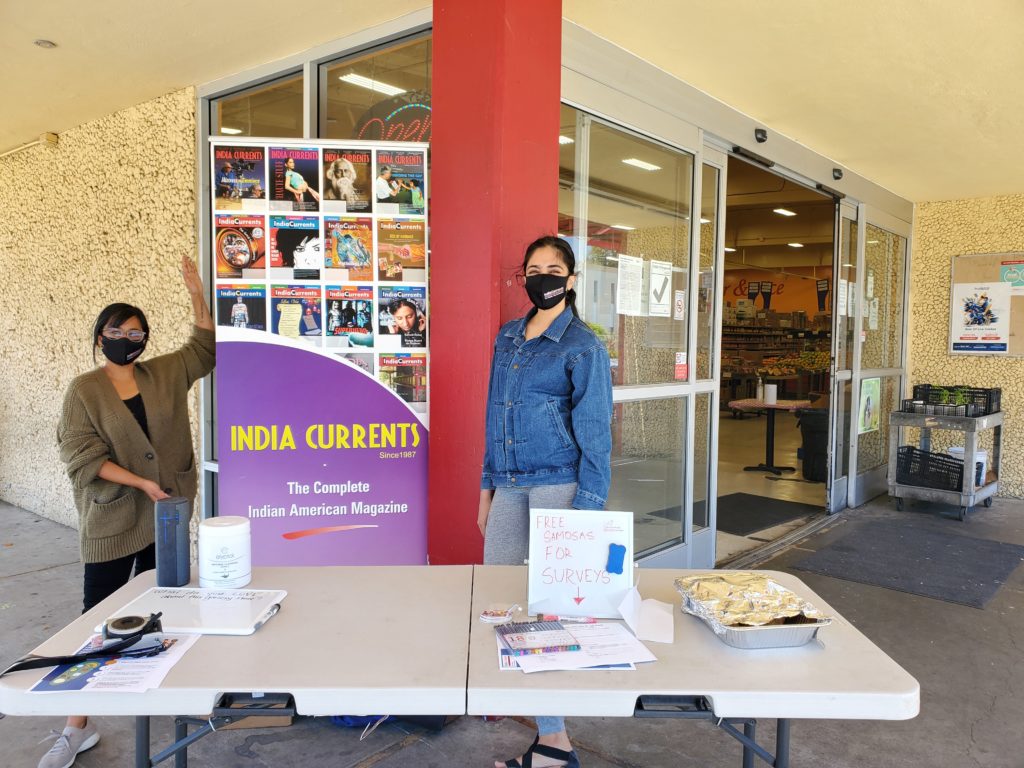
In 2018 we became 100% digital. Now our local stories draw readers from around the world, as well as our Bay Area audience. Stories with cultural ties still resonate with our readers.
Through audience analytics, surveys and community outreach, we keep a finger on the pulse of our multilingual community and the issues that matter to them.
Google Analytics says we reach over 120,000 users, over 60,000 social media followers, 15,000 email subscribers and 45,000 unique visitors to the website every month. Our audience includes women (49.3%) and men (50.7%) aged 25 to 65.
Our latest survey shows 55% of our audience is interested in heritage arts and culture, while 45% want information on social impact issues and stories on immigrant life in America. About 35% enjoy community opinions on every topic.
Tell us a bit more about the coverage India Currents produces. How do you determine the stories to tell that will most help or most impact your target audience?
We offer the Indian American community a platform to share familiar stories, explore hyphenated identities and discover how they can participate in local and civic engagement.
Our content has evolved over the years. We initially focused on culture and heritage to preserve links to India, but, as the booming tech industry drew thousands of Indian people to Silicon Valley as IT talent, our content responded to their needs. We ran stories on raising families in a new homeland, the dilemma of being immigrants on H-4 and H-1B visas, crises in the community, representation in the media and the struggle between acculturation and assimilation.
Today, as a nonprofit, we focus on social issues that impact our lives and guide new immigrants into the mainstream. We run stories on why census participation and voting matter; we showcase Indian American contenders for political office and keep readers updated about the COVID-19 pandemic, activism, elections, climate change and redistricting, among other topics of critical import.
Could you tell us about your community storyteller program?
We modeled India Currents on the Metro, a weekly magazine that was a great resource for local happenings. Due to limited funds when we launched, we reached out to readers for tips on upcoming events and asked them to share stories about their lives.
Today that’s called “crowdsourcing!”
Community storytellers were eager to share their stories with a wider audience. There was no other platform where everyday readers could submit their stories. Our writers had day jobs and writing was a hobby. Nevertheless, they grew experienced in the craft of writing, helped by our in-house editors. Several of our contributors went on to get published in the mainstream press and signed book deals after getting their start at India Currents. Some of them, like Sandip Roy, Kalpana Mohan and Jaya Padmanabhan, are now recognized writers and speakers.
We still crowdsource stories from our community and our team of editors selects, edits and publishes them. Every month, we send an email out suggesting a theme and seeking stories that speak to the zeitgeist. In 2020, for example, our audience shared stories on the pandemic-enforced new normal, BLM’s impact and the first woman of color on the presidential ticket.
We have a youth editor who curates stories for the next generation who see India Currents as a bridge to their culture and heritage.
Every year we also sponsor a cohort of high school and college students who we mentor and train. Our process invites emerging writers to share their work under the guidance of our experienced editors. Several of our interns have become professional writers.
How do you track the impact of this work, both the editorial coverage and the storyteller program?
We use Google Analytics to track the reach of every article and give us insight into what resonates with the community.
Our editorial team works closely with contributors to develop each story — whether it’s an original piece or one we’ve commissioned. This year we had contributions from 128 community journalists.
Our award-winning stories reflect the impact of this work — and validate our model. In 2020, ten of our writers won awards from the San Francisco Press Club. Seven writers won recognition at the California Journalism Awards hosted by the California News Publishers Newspapers Association, for coverage of the COVID-19 pandemic, and fallout, as well as coverage of local elections.
“Our strategy with funders is to highlight the unique value we deliver to a niche community — but sometimes that’s not enough to win the funding we desperately need to scale up or invest in infrastructure. Since we are unknown to the grants/foundations world, we’ve learned we need allies to vouch for us.”
Vandana kumar
Some ethnic media outlets tell us that funders can struggle to understand the value an outlet like India Currents provides. Do you relate to this? What tactics are most effective in communicating your work to the funder community?
Yes! I absolutely relate to this! Here are some comments I have heard from funders: “We don’t care for cultural stories. What’s the public good?” Or, “You have an international and national lens and do not focus on the news and information needs of local underserved communities.”
All ethnic media have dedicated audiences because their reporting is through a cultural lens. But it’s a stepping stone for engaging audiences in broader inter-ethnic communication and in diversifying the wider civic realm.
Our strategy with funders is to highlight the unique value we deliver to a niche community — but sometimes that’s not enough to win the funding we desperately need to scale up or invest in infrastructure. Since we are unknown to the grants/foundations world, we’ve learned we need allies to vouch for us.
Having champions to boost our value has gotten a funder’s attention. For now, that’s been an effective tactic in communicating our work to the funder community.
Anything else you want to mention about how India Currents serves people of color in your community?
We offer a unique model for community journalism. We’ve successfully engaged with our desi target audience for over 30 years by offering authentic storytelling by and for people of color.
We’ve stayed true to our mission. And we’ve used innovative methods to make sure we reach our readers, wherever they may be — last year we promoted the census by collaborating with our network of community leaders to reach their followers via WhatsApp. We’ve also developed partnerships with other local outlets — Ethnic Media Services, DingDing TV, and East Palo Alto Center for Community Media — so we can collaborate on initiatives for greater social impact.
India Currents is led by a majority-female editorial team and board of people of color. Our staff represent the diversity of the people we serve.
What advice do you have for other news organizations who want to better serve people of color within their communities?
Our longstanding roots in the community make us a trusted messenger. So, grow roots in the community you want to serve. Reach out and connect with your intended audience to understand what matters to them. Then deliver that. Don’t assume you know what they want.
What’s next? Is there a story you’re looking forward to in 2022?
I got a new story idea when I heard from a reader who had moved into an active senior living facility in Southern California. After retiring from a successful career, he is struggling to feel visible in his new environment. Since there is a growing South Asian population that is aging, we are wondering: are senior living facilities prepared for this diversity? That’s a story we will explore in 2022.
What’s next for us? The challenge for India Currents, and all ethnic media, is finding a sustainable model for this community representation. Building a new revenue model using memberships is a daunting task for most small outfits. It requires resources, knowledge, mentoring and a tech stack that is vital for these operations. That’s going to be my focus in 2022!
Q&A with Giles Morris and Sarad Davenport: How a newsroom partnership created a ripple effect
Who: Giles Morris, executive director of Charlottesville Tomorrow, and Sarad Davenport, content manager and digital strategist for Vinegar Hill Magazine.
News outlet: Charlottesville Tomorrow and Vinegar Hill Magazine
Size of outlet as of January 2022: Charlottesville Tomorrow is eight full-time employees; Vinegar Hill is one full-time employee
Outlet launch year: Charlottesville Tomorrow launched in 2005 with a re-start in 2018; Vinegar Hill launched in 2012
Hi Giles and Sarad! Can you talk about the partnership between Charlottesville Tomorrow and Vinegar Hill Magazine, as a preface to our conversation?
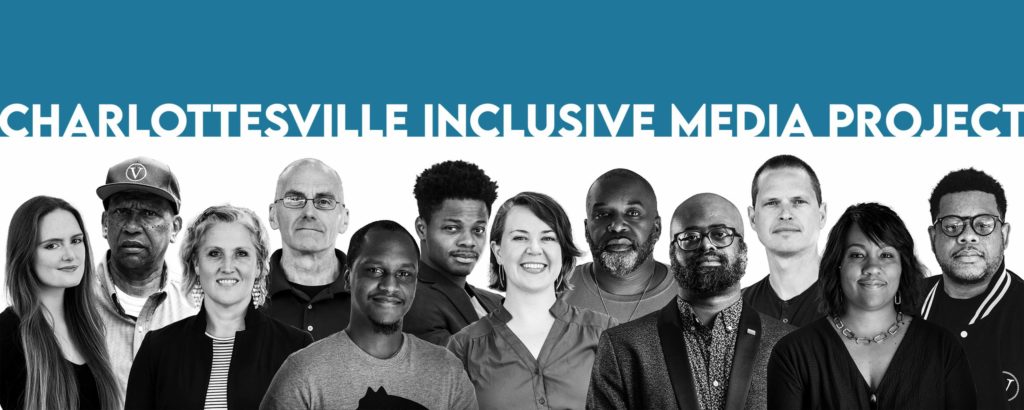
GILES: We are two of the three founding partners of the Charlottesville Inclusive Media project (CIM), which aims to create an inclusive and diverse media ecosystem in Charlottesville. We work together editorially, as business ventures and in the community to achieve those outcomes and build new audiences. Charlottesville Tomorrow is a nonprofit news organization and an INN member and Vinegar Hill Magazine is a Black-owned for-profit media and merchandising company. Our third partner is another local Black-owned media company, the In My Humble Opinion talk show.
SARAD: This partnership took several years to develop. The Vinegar Hill team needed a mutually beneficial relationship and an understanding we would operate as equals. The Charlottesville Tomorrow team, with more resources and back-office infrastructure, needed to value our agency and deep rootedness in Charlottesville’s Black community. Not only that, but we brought technical expertise and innovation that helped Charlottesville Tomorrow expand its reach and bring authenticity and culturally inclusive intentionality into its newsroom.
Tell us a bit about your news outlet. What sort of services do you provide? What’s your outlet’s primary mission?
GILES: Charlottesville Tomorrow is a hyperlocal nonprofit news organization with a public service mission. Our primary mission is to serve the community’s critical news and information needs by exercising the values of truth, community and equity through our journalism.
From 2005 to 2018, the organization focused its coverage on local land use policy and, after 2013, K-12 education in Charlottesville and Albemarle County. It relied heavily on a decade-long content partnership with The Daily Progress, the daily newspaper of record for a century, for distribution and visibility. Following the departure of its founding executive director and in the wake of the white supremacist rallies in Charlottesville and the accompanying local reckoning with racism in our community, Charlottesville Tomorrow changed its mission in 2018, under my leadership. We began the process of becoming a public service news organization capable of serving the entire community, with a focus on equity. We ended our partnership with The Daily Progress and became a standalone digital news outlet.
SARAD: Vinegar Hill Magazine began as a tool to offer the community a more inclusive perspective and give an asset-based lens to news from the Black community in Charlottesville. Staying true to this mission and intent has only helped Vinegar Hill since the early days. We curate stories with the Black community in mind, and amplify and launch Black entrepreneurs, artists, professionals and innovators.
Sarad, can you say more about Vinegar Hill’s news lens?
SARAD: What I mean by asset-based is that much of how we frame the existence of people of color, and Black people in particular, is as a problem that must be solved. Deploying this framework reinforces these ways of viewing society. Often these exaggerations are intentionally sinister and, I believe, become self-fulfilling. What is more true is that life is complex across race and culture and there is no lack of innovation, but there is often a morbid lack of resources. Where there are resources and innovation, these stories don’t seem to be appealing to legacy media, so we see it as our responsibility as Black media to cover the untold greatness and continue to mine for the genius that exists. The glass is not always half-empty for Black people, it is often full and running over, but that [story] does not often serve a pathological social construction.
Tell us about yourself! When did you start working at your news outlet? What does your role look like?
GILES: I became Charlottesville Tomorrow’s second executive director in spring 2018, arriving with a mandate to “take the organization to the next level” after a period of revenue and audience stagnation. I had left the journalism industry in 2014, thinking at the time that I would not return. My reason for wanting to run Charlottesville Tomorrow was that I believed our community’s news and media organizations were going to be incapable of dealing with our community’s reckoning with racism and inequality. I felt at the time, and still feel, that the failure of local news business models contributes to the passive racism that local media adopted over a period of decades. My role was to lead the organization through this transition at all levels — staffing, revenue, journalism, mission, board makeup, distribution — and to build an organization that treated its own people and its community with the dignity, value and respect they deserve.
SARAD: I came to Vinegar Hill when it was a newsletter, primarily as a layout designer, in 2012. As an undergraduate, I had a paid internship with The New York Times Company and I was able to leverage many of the skills I learned with Vinegar Hill. A few of the things that have been developed or transformed in my tenure so far are the layout and document design, adding freelance writers and photographers, building a sales team, monetizing the publication, adding and monetizing the website, and adding a merch component to the magazine, among many other things.
The biggest support I’ve given to the magazine is likely strategy and positioning. During my tenure, we have secured the partnership with Charlottesville Tomorrow and won several grants and other awards in a very short period of time. My job continues to be to help develop Vinegar Hill into a sustainable operation.
“I felt at the time, and still feel, that the failure of local news business models contributes to the passive racism that local media adopted over a period of decades. My role was to lead the organization through this transition at all levels — staffing, revenue, journalism, mission, board makeup, distribution — and to build an organization that treated its own people and its community with the dignity, value and respect they deserve.”
Giles Morris
Who does your outlet primarily serve, and how do you know this? Is your current audience different from who your outlet intends to serve?
GILES: Charlottesville Tomorrow, as a legacy outlet in transition, has had to work very hard to shift its audience and to build the newsroom capacity to serve a larger and more diverse audience’s needs. Its historic reading audience was what might be defined as the privileged information class, the group of news-obsessed, affluent, older and largely white people who have the time and energy to consume multiple national news outlets in addition to multiple local news sources each day, because it benefits them either economically or socially. They came to Charlottesville Tomorrow for its in-depth approach to coverage at a time when for-profit news outlets were scaling back coverage and producing less original reporting.
As in many cities around the country, Charlottesville’s Black reading audience has had little to no trust in local news, having experienced a long history of being treated as targets of crime coverage or having their voices silenced, or being treated as a minority monolith where only a few people’s voices were sufficient to adequately communicate the vibrance and value of its people. At Charlottesville Tomorrow, we knew that our long-term goal of serving our whole community in all of its diversity and vibrancy had to start with winning back the trust of African American news readers.
SARAD: The Vinegar Hill publication was created to set the record straight about Black life in Charlottesville, which was often misrepresented in legacy media. We had a specific intent to tell the story of Black people in a way that recognized their fundamental humanity and wasn’t subservient to the status quo and the more nefarious social narratives about Black people. Our intent was countering the exclusive and pejorative narrative about Black people by legacy media organizations.
We knew that the stories of Black Charlottesville have been underrepresented and often misrepresented by local media for ages and it was time for a change. From the outset, we employed some of the best writers, social commentators and subject-matter experts to provide content. Quickly, we built a grassroots following with deep engagement across the socioeconomic spectrum. We worked to unearth the stories and the innovation happening in the Black community that were not on the radar of other media outlets.
Through this process not only did Vinegar Hill connect a fragmented community but also grew that community and provided a space where the tough issues of the day could be contextualized and explored. We hope the magazine grows regionally and nationally and has ripple effects, challenging media professionals broadly to expand their perspectives in ways that inform social policy and build holistically healthier communities.
Once you knew the outlet needed to get more intentional about creating coverage for and about your Black audiences, what did you do?
GILES: We co-created the Charlottesville Inclusive Media project to partner on audience engagement, distribution and capacity. Together we work to reach Black audiences on radio, podcast, video and digital news channels and create a more inclusive local media landscape. As a result of the partnership, we have grown and diversified our audience, created new revenue opportunities and launched new initiatives and products.
We surveyed our CIM audience in partnership with Listening Post Collective and that has helped us understand who our audience is and how our Black audiences are experiencing our content. The survey’s results show that Charlottesville Tomorrow’s reading audience is 30% African American, nearly double the demographic of our reading area in the city and county. I think that is the result of a number of different strategies leveraged by and centered on the partnership. We have done a better job of moving towards Black audiences where they already are, like being on talk radio every Sunday with In My Humble Opinion. We have created new conversations, like Black Truths/White Truths, that show our deeper commitment to long-term change in our community, and we have co-produced and co-published interesting projects together, like the Determined and Still Determined series. We still have a long way to go, but the path is much clearer now than it was before.
SARAD: We started with the intent to create coverage for and by our Black audience at the outset and this was our primary mission: going beyond news and journalism as a convener of disconnected communities, highlighting the complexity of the joy and pain for Black people in Charlottesville. Partnering with Charlottesville Tomorrow and the In My Humble Opinion talk show served as a way that we could continue to grow our audience and reach a larger number of people in the community. We felt like we had a product that needed to reach more eyes, and the partnership with legacy media was going to elevate our profile.
How are you measuring the impact of that work?
GILES: It can be really hard and, I believe, unhealthy to measure the impact and return-on-investment of partnerships like this analytically. But at the same time, if we don’t measure the impact and communicate it to our community and our funders, we won’t get very far. There aren’t good enough local media ecosystem baselines to measure the more far-reaching impacts of this kind of work. At the organizational level, we can stick to the basics and try to measure accurately through time to get a sense of short- and long-term progress: revenue, audience growth and diversification, and impact on the media ecosystem.
SARAD: In order to remain relevant and sustainable, Vinegar Hill needed a larger platform to extend our reach and resources to shore up our infrastructure. This continues to be a struggle but this relationship has put us in a position to build some technological infrastructure, add sales apparatus and continue to be seen as a resource in the community. As of January, we have 6,545 contacts and 5,697 of them are subscribers, and in 2021 we had nearly 70,000 total website page views.
What advice do you have for other news organizations who are hoping to partner with ethnic or community media outlets?
GILES: People underestimate the value of partnership because they are focused on concrete goals and often find themselves understaffed facing Catch-22 situations with respect to diversifying and growing their audiences. Partnerships seem either hard and messy (they are!) or shallow and transactional — too much to take on or a waste of time. One of the most valuable parts of the CIM partnership for Charlottesville Tomorrow has been the relationship with our partners and the insight and perspective they bring to our internal and external processes.
But even deeper than that, CIM’s progress in influencing the larger media landscape through our ally relationship has been much faster than I could have imagined and solved many problems for Charlottesville Tomorrow that we did not even realize we had. For instance, our young white reporters routinely say that our partnership and our focus on reaching Black audiences is one of their primary motivations to work for us. Also, our partnership has made us more creative and flexible in creating new products and revenue strategies, because our partners are for-profit and have ideas and perspectives that we do not have.
Today, Black-owned media is taking off and white “allies” are knocking on the door with many motivations. To have a successful partnership experience, legacy outlets have to be clear, committed, humble and open to change. You have to believe that you need your partners more than they need you and treat them accordingly. And when you do not see eye to eye, you have to come back to basics with each other to move forward. Why are you doing this work? If you can’t answer that question every day, the partnerships will fail.
SARAD: We were certainly skeptical at first, but we had some small and large wins early on with the Determined series that gave us more reason to trust. I encourage people to study the history of the Black press and its early intent. I would also tell legacy outlets to position yourselves in the posture of listening and not as an authority on issues particularly related to Black people and other people of color. Find innovative ways to allow their authentic voice to come through in ways that lead to action as opposed to being nuisances of the local and regional economic and political machinery. It is important to see lived experience as valuable, and as valuable as [training] in journalism.
People should also encourage discussion — and disagreement, for that matter — to ensure that the very best and most innovative decisions come out of the ideation process. It is important to be open and transparent to a fault so there is no speculation about hidden agendas and people can speak from a place of equal standing where power is not used as leverage — ever. Black media also needs to be able to remain semi-autonomous. Most Black-led media organizations do not have the back office and infrastructure of most legacy media organizations and need to be nimble and innovative. This requires flexibility; rigid arrangements that feel like control are discouraged and are in my opinion counterproductive to the overall return-on-investment of the partnerships anyway. Control is not the answer. Authentic collaboration absent of power dynamics is critical from the ideation phase through execution.
We have committed ourselves to intentionally exist within the tension. We know that power dynamics and old ways of being have the tendency to creep into these types of arrangements. Tackling these questions together without losing our identity and rootedness is and will always be a challenge, but in the tension we seek a higher order of being, not only in journalism but in the community and world. It’s hard work, we have to be very thoughtful and trust comes with time. Leaving space for each other and also speaking together at times is important.
“…Position yourselves in the posture of listening and not as an authority on issues particularly related to Black people and other people of color. Find innovative ways to allow their authentic voice to come through in ways that lead to action as opposed to being nuisances of the local and regional economic and political machinery. It is important to see lived experience as valuable, and as valuable as [training] in journalism.”
Sarad Davenport
What’s next? Is there a story you are looking forward to in 2022?
GILES: Sarad has been working with Charlottesville Tomorrow’s new editor-in-chief, Angilee Shah, and In My Humble Opinion’s Charles Lewis to design a new collaboration effort for the CIM project. The working name is First Person Charlottesville — a multiplatform channel and community around a year-long narrative series of first-person testimonies about life in our community. We are still looking for an anchor funder, if you are as excited about it as we are!
SARAD: We are very much interested in the economic revolution happening in the Black community. More Black-owned restaurants than ever have opened in Charlottesville in the last two years. There is an idea that the COVID-19 pandemic can be a portal to a reality where people are tapping into their entrepreneurial instincts and becoming less dependent on employment as a sole source of income. This sense of self-determination is a real phenomenon for Black people. Our government has failed us, our schools have failed us, the criminal justice system has failed us, and it is up to us to leverage all of our capacity to save ourselves. Relatedly, we are deeply interested in virtual reality and ways that the Black community can stay informed and a part of the growth and commerce there. There is so much to cover, but I believe economic development in the Black community, closing the wealth gap and forceful resistance to it will be the story.
Q&A with Keri Mitchell: How Dallas Free Press uses text messages and community events
Who: Keri Mitchell, executive director
News outlet: Dallas Free Press
Size of outlet as of January 2022: 3.5 full-time employees
Outlet launch year: 2020
Hi, Keri! Tell us a bit about your news outlet. What’s your outlet’s primary mission? What sort of services does Dallas Free Press provide?
The primary mission of Dallas Free Press is to amplify voices in disinvested Dallas neighborhoods and explore solutions to our city’s systemic inequities. We focus our community journalism efforts on the South Dallas and West Dallas neighborhoods, and we partner with the Dallas Weekly, a legacy Black newspaper in South Dallas. We do a lot of showing up and listening at community gatherings and spend a lot of time building relationships. We use those experiences to decide what topics and issues to tackle, and what needs to be communicated via text versus social media versus a story on our website.
Could you tell us more about yourself? When did you start working at Dallas Free Press? What does your role look like?
I’ve been a community journalist my entire career. I started at small newspapers in the Houston exurbs and when I moved to Dallas, I went to my local library branch and found this magazine in a lobby news rack called the Advocate, which covers several Dallas neighborhoods. I recognized it as community journalism but with a magazine approach, which I loved because I’ve always been better at the big picture, why-it-matters side of journalism. That was in 2005, so I went through all of the revolutionary changes to digital journalism and advertising on the job.
In 2017 I wrote a story trying to demystify the politics of the local school board — local Dallas elections are nonpartisan — that was well read and respected. But I flat out didn’t have the resources to do everything I wanted to with the story. We had to keep churning out more website stories and fill up next month’s magazine to stay in business, so I left a lot of good reporting behind. And even if people loved my story, I couldn’t compete with the barbecue restaurant opening down the street in terms of web clicks.
I finally came to terms with the fact that if we want to do civic journalism that sheds light on big issues, and we want to serve communities where advertisers aren’t interested in eyeballs, communities who don’t have the resources or the trust to subscribe, we have to find a different way. I started looking at news efforts across the country, and I saw that this kind of journalism could be possible with a nonprofit business model. So after a lot of research and a lot of prayer and a few panic attacks, I launched Dallas Free Press in January 2020.
Who does your outlet primarily serve?
South Dallas and West Dallas, where we focus our community journalism, are historically redlined neighborhoods where the vast majority of residents are Black and Latinx.
Dallas Free Press uses text messaging as the main form of communication with residents of South Dallas and West Dallas. Could you tell me more about why and how you chose this strategy?
It’s a pretty simple answer — our readers told us to. Even before launching Dallas Free Press, as we discussed the idea of a community newsroom with West Dallas leaders, they told us, “If you try to do this with email, you’ll fail.” They said we needed to get information directly to people’s phones. They also told us that if we didn’t have Spanish-language content, we would fail. So before we even had a website, we launched our texting service in both neighborhoods, and in both English and Spanish for West Dallas.
Talk me through the workflow here. How do you decide what gets texted? Who leads this work? How many team members does it require?
We actually launched the service with two very talented bilingual interns — one studying to become a journalist and one a community organizer — who carried it for the first few months. It started mainly as a way to communicate about COVID-19; we sent at least one text a week with the neighborhood’s case numbers (by zip code) and trends, as well as some sort of resource, such as a new testing site or a food drive-through. When the vaccine rolled out, we switched to the neighborhood’s vaccination numbers and neighborhood vaccination rates. We announced via text when they had reached herd immunity.
What kind of testing and learning did you have to go through to get to this workflow and process? Any mistakes made along the way?
We’re still learning! As we expanded beyond COVID-19 to other topics, we had a few weeks that we sent a text every day. We saw people start to unsubscribe and we pulled back. We’ve found a sweet spot in up to three texts a week — usually some sort of resource, an event and a round-up of neighborhood news. Ideally we pre-schedule these, but news is news. One issue has always been translation, which meant we often delayed the Spanish version of our texts, and sometimes weren’t able to send them at all. Now we have a bilingual journalist on staff, which makes a huge difference. We’re working on a more conversational tone, which our texts have always had to some extent, but we receive more responses with questions, prompts and such, so we’re trying to be more creative. Which can be challenging with only 640 characters!
What have you seen as a result of this work?
The main challenge is getting people to subscribe, which most are willing to do at the neighborhood events we attend, either for a $5 gift card or just because they want to. We haven’t had a lot of success asking people to sign up digitally, but we’ve had a ton of success via in-person interactions, so we’re putting our efforts there.
I’ve been surprised and thrilled that very few people have unsubscribed from our texts. We’re clear about who it’s for — people who live or work in our neighborhoods — and what it is — news, information and resources specific to the neighborhood. Like our West Dallas friends told us, when we give people the option between email and text, they almost always choose text, or both. I love that people respond to our texts, sometimes even with just a simple, “Thank you,” which means so much. We pay attention to the responses, and we use them as a barometer to determine what else we should — and shouldn’t — cover.
Besides text messaging, how else is Dallas Free Press thinking about reaching and serving communities of color?
We’re thinking about how partnering with neighbors and community organizations on events has fostered trust and enabled reach, and has been much more effective than hosting our own events.
How are you measuring the effectiveness or impact of this work?
We conducted this survey in partnership with UT Austin’s Center for Media Engagement in early 2021 as the baseline for our organization’s work in our neighborhoods, and will continue building on that research each year.
What advice do you have for other news organizations who want to start better serving people of color within their communities?
Show up. Over and over and over again. Show up at run-of-the-mill meetings and celebratory community gatherings so that people don’t just associate you with crises and chaos.
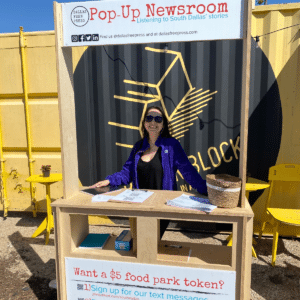
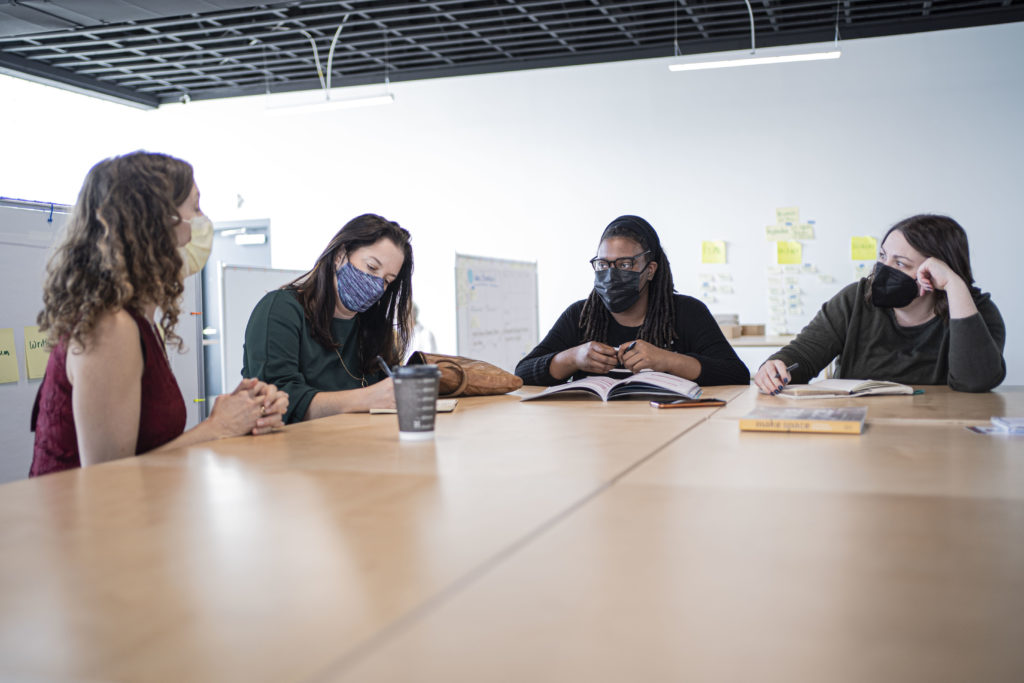
Dallas Free Press’ pop-up newsroom makes the rounds to local events, like this one in South Dallas, where intern Vivian Berreondo invited neighbors to take surveys and sign up for text messages. Photo by Keri Mitchell
This was the advice given to me by a South Dallas community leader as I started exploring the possibility of Dallas Free Press: “We want to see you, hear you, smell you, touch you, taste you.” It may sound cringy, but after years of community journalism, I knew exactly what he meant: If you show up, it means you’re listening and you care. It means you’re willing to focus your time and energy on us. And if you show up, we’ll get to know you and begin to trust you.
We don’t often think of showing up as part of journalism. We’re supposed to be outside observers, not active participants. That may be true regarding elected officials or those who hold power, but it’s not true for community journalism, which always carries an inherent bias toward the communities it covers. This is even more crucial in communities of color, where explicit bias is really more of a centering and amplifying of Black and Brown voices.
What’s next? Is there a story you’re looking forward to in 2022?
We worked hard last year to solidify the new Dallas Media Collaborative, and I’m excited about the stories we’re exploring together on housing justice. We’re also adding a Report for America fellow to our team; that role, coupled with another initiative, will change the way we cover public meetings and civic issues.
I can’t wait to see the stories published by high school journalists who are part of our pathway from Dallas high schools to Dallas newsrooms, and I’m loving working with an incredible local storyteller on a movement journalism project around the history of Dallas’s Black schools.
I’m most excited about pushing the envelope on what journalism looks like. Because of our nonprofit model, we don’t have a publication to fill, weekly website click quotas to meet or anyone to answer to — except our South Dallas and West Dallas readers. So we’re free to ask:
What matters most to our neighbors? And what are the best ways to tell those stories?
Q&A with Irene Romulo: How Cicero Independiente identifies community information needs
Who: Irene Romulo, development coordinator
News outlet: Cicero Independiente
Size of outlet as of January 2022: Two part-time contractors
Outlet launch year: 2019
Hi, Irene! Could you tell us about your news outlet? What sort of services does Cicero Independiente provide? What’s your primary mission?
Cicero Independiente is an independent, bilingual news organization serving the people of Cicero and Berwyn, Illinois. Both communities are majority Latinx, working-class towns with a history of corruption and what seems to be a hesitancy to adapt to changing demographics. For example, although monolingual Spanish-speakers comprise a large part of the community, public meetings do not provide interpretation or translation services, making it difficult for people to engage in local democracy. Our reporting meets the needs of our community by connecting residents to crucial information about local resources, amplifying residents doing good things and investigating local government agencies to push for accountability and transparency. We also pay and mentor local youth to report on issues that matter to them, such as this feature by a past youth reporting fellow.
Tell us about yourself! When did you start working at Cicero Independiente? What does your role look like?
I am one of the three cofounders of Cicero Independiente. When we first launched all three of us wore many hats, but now I focus on our fundraising and community engagement. A lot of what I do is heavily influenced by my experiences as an organizer. Everything we do comes down to building strong relationships with our neighbors and partners so that our journalism is reflective of what our community needs, and making sure our journalism is accessible.
We recently interviewed some of our readers about their information needs as part of our work with the Listening and Sustainability Lab. One of them said she wants local organizations to be both community-needed AND community-wanted. We know we’re community-wanted because of the outpouring of messages, news tips and support that we receive from local residents both in person and online. Our hope is to remain that way.
Who does your outlet primarily serve, and how do you know this? Is your current audience different from who your outlet intends to serve?
Our primary audience is the Latinx, bilingual community of Cicero and Berwyn. We want to serve people like our parents: immigrants, monolingual Spanish speakers who have specific needs and many stories to tell but who are often left out of mainstream media. We also want our work to center and amplify the experiences of bilingual youth of color who are the driving force behind local organizing efforts. All of our coverage features local experts and community members. We also spend a lot of resources conducting off-line outreach to ensure we’re reaching people who have little to no access to our online content.
Although not currently our primary audience, we also realize that we have a big opportunity to amplify and build relationships with the small, but growing, Black population in this town. Cicero is a former sundown town and non-Black Latinx people have benefited from, and sometimes been behind, anti-Black violence. We have a duty to make sure that we don’t erase or ignore the stories of Black residents.
You mentioned specific needs. Could you tell us more about Cicero Independiente’s approach to discovering information needs?
Before we even launched, one of our cofounders conducted extensive interviews with local residents at a coffee shop to learn about the topics that interested them the most.
Then at our launch event, which was kind of like a big block party with a film screening, we also asked attendees about what we should cover. After we launched, some of our team members used to spend a lot of time talking to people at bus stops and laundromats to learn about their information needs. These efforts were paused when COVID-19 pandemic restrictions were put in place, so we shifted strategies. We’ve conducted online surveys and Zoom interviews with community members but the most important shift we made was joining existing community spaces to learn about information needs.
How did you go into the community without being intrusive?
Instead of creating new spaces to reach people, we asked if we could join local coalitions. This included a COVID-19 working group composed of local agencies, representatives of elected officials and local parents. We knew the meetings were public and open to any Cicero resident but we wanted to make sure that our presence as media would not create discomfort for attendees. Before we showed up, we asked organizers if we could attend and we made sure to explain that we wanted to join in order to learn how we, as a media organization, could help make more information accessible. When we’re in the spaces, we also make sure to let people know that everything they say is off the record. If we want interviews, or to share anything someone says, we’ll ask for permission first. We’re building trust, and transparency about our intentions is crucial.
What were the information needs you unearthed, and how has your outlet met these needs, particularly for communities of color?
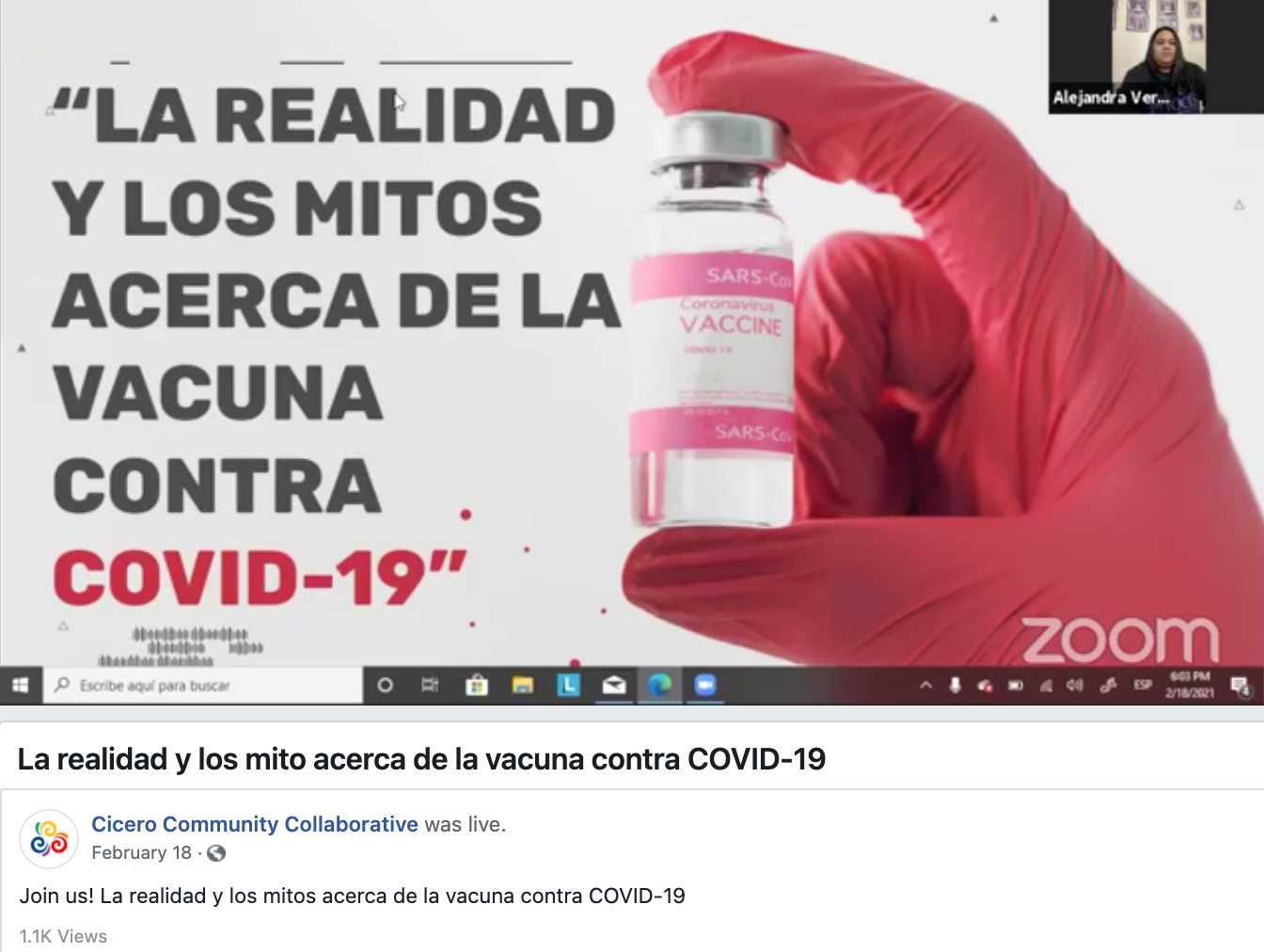
One of the coalitions we joined is the COVID-19 working group. At those meetings, our role is to listen, take cues and meet information needs when we can. We’ve partnered with members of the group to host virtual events, create updated resources and investigate the local government’s response to COVID-19. We’ve also created explainers and social media graphics based on questions that have been brought up by parents at those meetings.
Everything we create informed by our involvement in these coalitions is always published in both Spanish and English. The investigations we publish are accompanied by useful information, such as this handy know your rights article that is also available as a poster.
How is your outlet making sure the coverage or product you produce is meeting information needs?
We ask. We’re constantly testing out different strategies to reach different members of our community. Although Cicero and Berwyn are majority Latinx communities, we are not a monolith. We need different information and we consume and access things differently. We’ve tried using online surveys, virtual interviews and, to reach younger audiences, quick Instagram polls. We conduct in-person outreach whenever possible.
We also ask other organizations to let us know how we’re doing. Many of them have long-standing relationships and day-to-day interactions with the people we want to reach so their feedback is valuable. We also know that not everyone who lives in Cicero and Berwyn has access to internet-based resources so we also print and distribute paper editions of our work.
Last summer we published an 11-part series documenting the uprisings that took place in Cicero, which recently won two INN inaugural awards. We wondered whether anyone had read them and so we sent out an online survey. One responder said, “I was hearing a lot about [what happened] in the news that didn’t come off the right way but the [series] captured what happened accurately.” This kind of feedback lets us know we’re doing something well.
Do you record that feedback? Where and how does your team review and incorporate the feedback you receive?
Yes! We use a Google form to track the messages, social media posts and in-person feedback that we receive. We’re not always the best at staying on top of it; we remind each other a lot so that we’re all contributing to keeping track. In the past, we’ve reviewed survey results during our team meetings and we’re constantly sharing insights on Slack. The editorial team, which is very small right now, uses the feedback to decide what stories we pursue with our limited resources. The feedback also informs our projects. Next year, we’re planning to launch participatory reporting projects that have been informed by Zoom interviews with our readers.
Anything else you want to mention about how Cicero Independiente serves people of color in your community?
In 2020, we launched a paid youth reporting fellowship. Participants receive journalism training and report on issues that matter to them. Running the fellowship is a lot of work but we think it is crucial that we create well-paid opportunities for young people to shape our newsroom. Two of the fellows that participated last summer are now members of our steering committee and are helping make decisions about the future of our organization. The majority of our reporting contributors and illustrators are also local youth who had never worked with a news organization. Working with them to produce stories they are proud of is a big lift and it often means that our stories take a bit longer to publish but it is worth it. By amplifying the work and the voices of people of color in our community we are helping to create more pathways for them. Some of the people we’ve profiled have received invitations to be speakers at major events after event organizers read about them on our website. Past writers and illustrators are now working with other newsrooms and getting paid to produce work that advances more equitable coverage of communities of color.
Irene, what’s next for you and Cicero Independiente? What are your plans for 2022?
This year we’re prioritizing our internal development. We’re a fiscally sponsored organization but hope to incorporate as a worker-led nonprofit in the future, so we’re working on our bylaws and figuring out what a community advisory board and membership would look like for us.
Q&A with Mareea Thomas: How WNIN shares people’s stories in their own words
Who: Mareea Thomas, Director of Digital Media at WNIN Tri-State Public Media and co-producer of the ¿Qué Pasa, Midwest? podcast
News outlet: WNIN Tri-State Public Media
Size of outlet as of January 2022: 21 full-time employees
Outlet launch year: WNIN incorporated with the state of Indiana in 1973. ¿Qué Pasa, Midwest? launched in 2017 through PRX’s Project Catapult.
Tell us a bit about your news outlet. What sort of coverage and services does WNIN provide? What’s your outlet’s primary mission?
As a dual radio and television licensee, WNIN provides NPR and PBS content as well as statewide and local news. WNIN primarily serves the greater Evansville area which includes parts of Indiana, Kentucky and Illinois. We also host a Radio Reading Service, in which volunteers read local newspapers for visually impaired listeners, and other local programs like the bilingual podcast ¿Qué Pasa, Midwest?. WNIN’s stated mission is to use public media to enrich people’s lives and better our communities. ¿QPM? serves Midwestern Latinos by sharing authentic, bilingual stories of Latinos living in the region.
Tell us about yourself! How did you get into radio, and when did you start working at WNIN? What drew you to ¿QPM? and what does your role look like?
I am from New Orleans and moved to the Midwest after Hurricane Katrina. In college I was a producer at the radio station for an international music show called The World Safari. In one of our segments I interviewed international students, which I loved—it’s still one of my favorite things I’ve ever worked on. I have always enjoyed talking to people from different countries and cultures.
I started working at WNIN in January 2016 as a radio host and producer. While I’m Black, but not Latina, ¿QPM? creator Paola Marizán invited me to co-produce the podcast due to my Spanish minor and production experience with The World Safari. In my current position I manage WNIN’s social media accounts and website in addition to producing ¿QPM?. After securing funding at the end of 2021, I am in charge of launching and managing ¿QPM?’s expansion into a bilingual reporting network.
¿QPM? is six years old! Could you tell me more about how this podcast came together? When did WNIN understand it needed to create a new product for Spanish speakers? How did you design the podcast?
Paola Marizán was reporting about Spanish speakers for WNIN, but her work wasn’t reaching the Spanish-speaking community. In addition to the stories being primarily in English for our NPR audience, they were aired on an NPR station with content geared towards white business professionals and scheduled during work hours. Paola (who works for America Amplified now) proposed creating a podcast since people can listen to it on demand, and it isn’t bound by the restrictions of NPR radio features in terms of length and language. The team took part in PRX’s Project Catapult, where we learned to use design thinking to come up with bilingual, eight to 15 minute episodes covering the stories, challenges and triumphs of Latinos living in the Midwest.
For more of our podcast origin story, check out Paola’s January interview with KQED’s Ernesto Augilar about the need for bilingual content.
Who does ¿QPM? primarily serve, and how do you know this? Is your current audience different from who your outlet intends to serve?
¿QPM?’s intended audience has always been Midwestern Latinos. However, we’ve seen that the stories appeal to people outside of the Midwest and to non-Spanish speakers as well. According to our analytics, quite a few of our listeners are located in Mexico and other countries, including Venezuela, which was a pleasant surprise.
Can you talk a bit about ¿QPM?’s approach to bilingual audio?
As a bilingual podcast, we actually do not use direct translations! We paraphrase things in English and Spanish. There’s a language mix so English-only or Spanish-only speakers understand most of the episodes. We made the decision early on that if a non-Spanish-speaker can’t understand every single word, that’s okay since they aren’t our target audience, and they can still get the gist of the episode. This medium means that you’re hearing the voice, hearing the dialect, the switching back and forth between Spanish and English—the authenticity of that.
Did the podcast team make any mistakes early on that helped with the podcast’s development? How has the podcast changed over time?
When we started, we were going out and looking for stories that we thought Midwestern Latinos would find interesting. Now we’re going to our collaborators and community leaders asking, “Who should we talk to? What should we talk about?” Moving forward we will be directly asking Midwestern Latinos what topics and issues they want us to cover.
In 2020, we were supposed to do a season about the election, but then the pandemic hit and it was all we could think about. There was a lot of fear, confusion and uncertainty. We realized we couldn’t even really “report” on the virus because there wasn’t enough information. Our collaborators agreed and we shifted to finding the people who were coming up with solutions. Ever since that season, I’ve felt like that is the path we should stay on, unless our audience tells us to do something else. Not just reporting and exposing problems, but also connecting people to problem solvers and solutions in the community. We don’t want to just tell Latinos’ stories, we want to listen, share stories, share information and connect people.
How do you think about or measure the reach and impact of this podcast? What sort of feedback have you received from its audience?
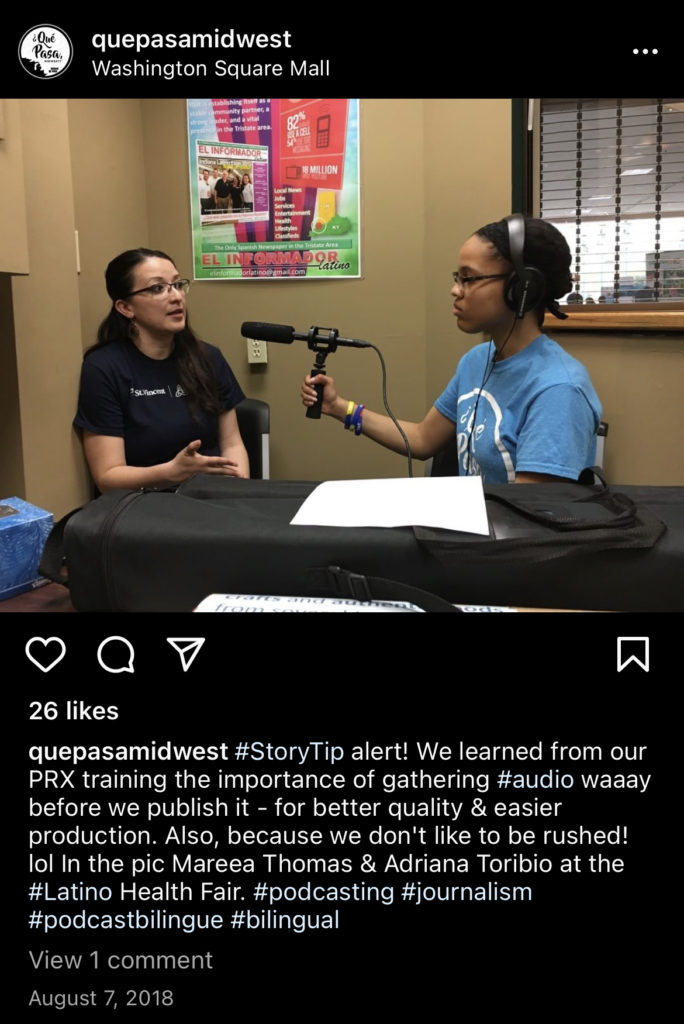
One of our goals in terms of reach is to have content originating from all 12 Midwestern states, but our reach and impact has been evident from how many Latinos inside and outside of the Midwest have shared positive comments about the podcast. Some of our feedback comes through our collaborators sharing episodes on their social media. Our episode on Latinos & Freedom of Speech was a collaboration with April Alonso, a multimedia journalist who co-founded the bilingual news outlet Cicero Independiente in Cicero, Illinois. Cicero Independiente tagged ¿QPM? in their episode post on Twitter which led to ¿QPM? receiving positive feedback from Illinois and beyond.
What advice do you have for other news organizations who are planning on launching a new product specifically for communities of color? What should they be thinking about early on?
Using community engagement to research the underlying issues is key. Establishing rapport with community leaders is important for building trust; our regional collaborators, community partners and organizations who already have connections in their communities are gateways to Midwestern Latinos. In a bilingual community, having a host like Paola who speaks the language—especially if it’s their first language—breaks down some barriers immediately.
Early on, it’s non-negotiable to have at least one team member who is part of the community. But that person can’t just be the face; they need to be a decision maker, and the organization must defer to their expertise. It’s essential that they be well compensated for their time, unique insights and talents. If the new product falls apart due to one employee leaving, then the organization can’t sustain that product in a meaningful way. Serving a community isn’t a one-person job; it needs to be a group effort, and it’s important to continue diversifying staff, increasing cultural awareness and providing adequate resources for the team long after launch. A culturally competent product requires stewards who ensure that people can speak their truth in their own words; this is a major way to change an industry primarily influenced by and catering to white audiences.
It’s also crucial to think about safety for the team members and people who share their stories. We have seen this with issues related to immigration, the U.S. Census, the 2020 election and COVID-19, for example. We have had at least one story that was compelling, but we didn’t release it because we realized that we could be unnecessarily placing the subjects in danger.
Prioritizing safety over producing a compelling story is a shift away from the mindset of seeking recognition and awards. Making the shift can be difficult because recognition is what brings revenue and revenue is what allows us to continue. Ultimately, serving communities is about providing value to them and putting their needs over content production.
What’s next? Is there something you’re looking forward to in 2022?
We received the seed funding to expand the podcast into the ¿Qué Pasa, Midwest? Bilingual Reporting Network which will launch later this year. With the network design, I’m thinking about increasing accessibility for people with auditory, visual and/or mobility needs. Our monthly newsletter will include a ¿QPM? episode and articles based on themes submitted through a WhatsApp group. We’re also exploring how to voice the written articles and transcribe the podcast episodes while maintaining our bilingual approach. A local professor is making our content into free lesson plans to serve younger generations, and we will also make broadcast features available to stations nationwide.