Nonprofit news organizations are constantly asking themselves the big audience question: “how can we better reach our audience and potential audience?” Many are turning to digital spaces: SMS text, WhatsApp and more. But some digital news organizations are finding success with a specific physical product: zines.
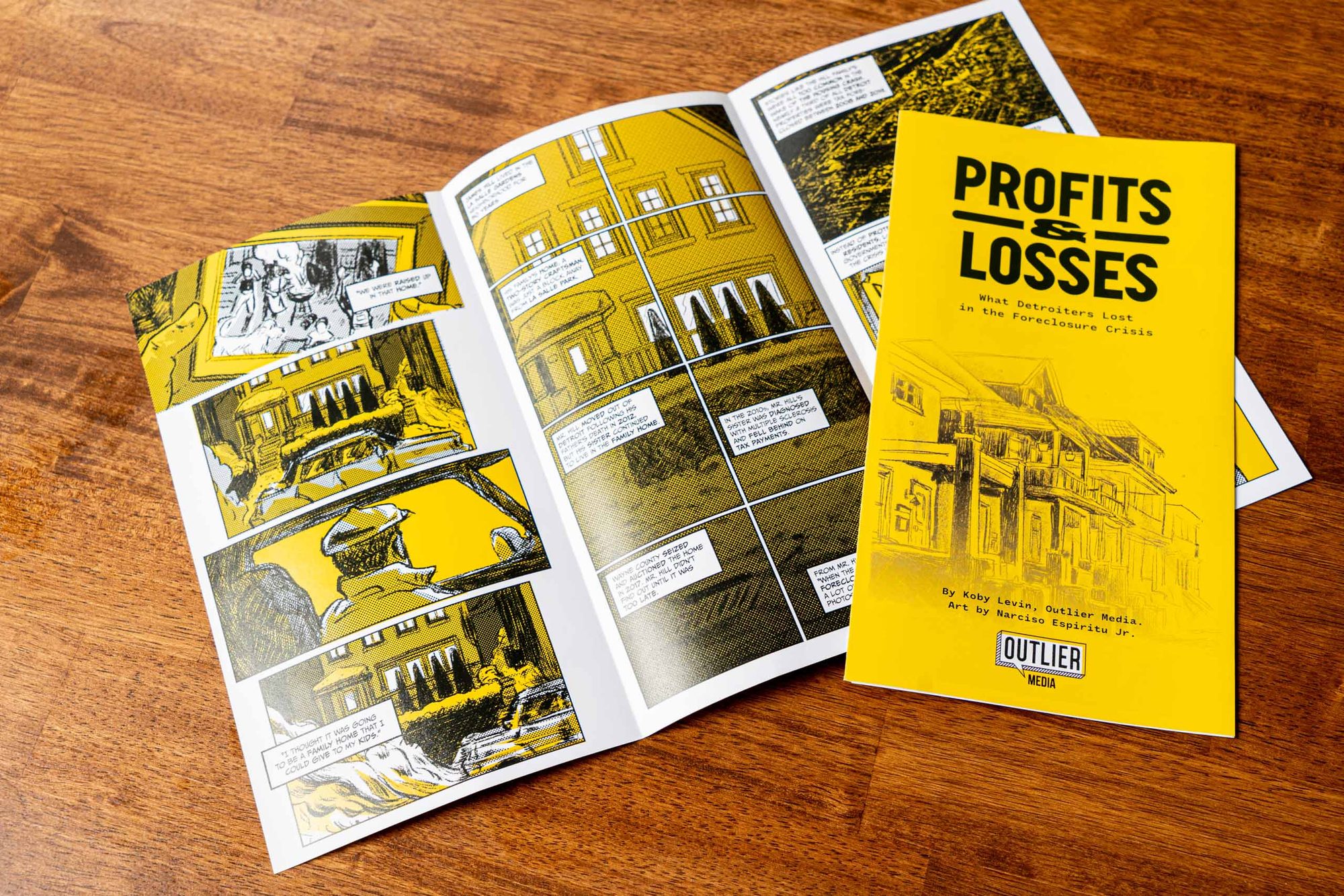
In June, Outlier Media, an INN Network member centering and responding to Detroiters’ needs, published its first ever zine, “Profits and Losses: What Detroiters Lost in the Foreclosure Crisis.” The zine was born out of reporting from Koby Levin, who found that after the county profited off of foreclosing on homes during the bankruptcy crisis in Detroit, the Supreme Court ruled that they had to return those profits to those homeowners – but the county didn’t publicize that, said Kiran Saini, Outlier Media’s audience manager.
So, Levin launched an effort to reach thousands of Detroit residents and help them reclaim the money they were owed. The reporting began in 2024 and continued throughout 2025. Over 16 weeks, Outlier Media — along with nonprofit partners and a lot of volunteers — reached hundreds of Detroiters owed a collective $5.9 million.
Using a zine to save and share stories
“For some people, it was thousands of dollars, which is a life-changing amount of money. These are people who lost generational wealth, their family homes, the houses they grew up in. Home ownership rates across the city declined. And so, we came up with the idea of preserving these stories. Even though they received this money back, it still doesn’t erase all of the pain that people went through,” Saini said.
The print format was an experiment for Saini and the newsroom. “We are constantly trying to reach people in different ways.”
Initially, once the reporting project was conceived, Outlier’s business team secured a $75,000 grant from Rocket Community Fund, a local foundation specializing in housing advocacy, to hire a (part time) project manager, as well as any other project related costs, which ended up including the zine.
The zine took about a year of production, Saini said. Saini found a local illustrator and printer in Detroit. The illustrator cost about $2,800 and the printing totaled $1,600 for 5,000 copies. When it was ready for release, she made a large distribution list of about 250 locations.
“It was really prioritizing what we call third spaces, where people go to hang out: coffee shops, grocery stores, community centers. We divided it by neighborhoods in the city, and then everyone on staff helped to deliver the zines.” Saini said they left about 10 copies per location, and she and her colleagues left their phone number with the locations so that they could drop off more if they ran out of copies. Outlier did a web and social media push with information – including an interactive map – on where to find the zines, as well as a free storytelling event at a local coffee shop. The event featured a Q&A between Outlier’s Executive Director Orlando Bailey and Levin, as well as an open mic inviting those who Levin worked with on the project to tell their stories. There was also a make-your-own-zine table.
Within the zine, Saini said they were intentional about how to bring the reader of the zine to Outlier, posing the question: how do we get folks further inside the funnel after they find us through a physical product? Saini said she was very anti-QR code, so instead she included the number of Outlier’s SMS service with a special keyword. She said they’ve gotten less than 10 text-ins using the keyword.
Looking back at the project, Saini recognizes that it was a very high-lift project, but it produced a meaningful product that got positive feedback. If they do another, it would likely be a lower lift, like a guide with useful information.
A ‘grassroots’ approach to a service-driven zine
INN Network member The Jersey Bee, a public service news organization in Essex County, New Jersey, recently released its fourth edition of its food aid zine, “Food pantries are for everyone.”
During COVID, The Jersey Bee saw that people were having a hard time figuring out where to get COVID resources and food aid, said Nikki Villafane, The Jersey Bee’s Engagement Producer. This led to the organization creating a food aid SMS hotline, where they sent texts letting people know which pantries were open and how to access them.
In 2024, they decided they wanted something they could take out to the community, and “reach people that we aren’t able to reach digitally,” Villafane said. “To have something where people could just have it in their back pocket, in their bag, on their refrigerator. It would have the most accurate food aid information, not just where to get food but how to sign up for WIC, how to sign up for senior benefits and sign up for SNAP.”
As for producing the zine, Villafane called their process “really grassroots.” She said that Simon Galperin, The Jersey Bee’s Director, is great with graphics – and produced the first version of the zine alongside a contract journalist at the time. Now, they just re-use that format in Canva, print the pages either at a local Fedex or their own printer, and the staff does the folding and stapling. Then, Villafane drops off the stacks at libraries, community centers and the food pantries themselves.
The biggest challenge is keeping the information up to date, Villafane said. “We don’t want people going to a location and nobody is there. We have to be consistent. I do visits to food pantries. I talk to the team members. I’m on a food health equity coalition for Essex County. I’m really trying to stay in the know with the food aid world.”
While The Jersey Bee doesn’t have a standardized reprinting plan, they do check the zines at least once a year and see if anything needs to be changed.
Her advice to a newsroom interested in producing a zine? Think about the information and its effects, she said. “Think about not just that information, but the long term effect of the information you’re putting in there. Is it there just for the moment or can you put something in there that’s a little bit more robust and will be lasting?”