When the Institute for Nonprofit News (INN) launched “Common Ground: What Rural Schools Mean to Communities” in August, six nonprofit newsrooms in our Rural News Network (RNN) set out to explore a deceptively simple question: What does a rural school mean to the place around it?
The answer, as the first round of reporting makes clear, is rarely just education.
A group of RNN journalists are spending the year examining the role rural schools play in their communities, with data analysis and support from Big Local News at Stanford University and funding from the Walton Family Foundation. The first round of reporting is now published, taking readers from remote ranch country in California to Minnesota’s Iron Range, an Ohio college town, Alaska’s Mat-Su Valley, the Mississippi Delta and Southeast Texas.
Across very different landscapes, the reporting finds a common thread: Rural schools often serve as some of the most important connective tissue for a community.
They can be gathering places, polling sites, food pantries, emergency shelters, health-care access points, sports facilities and sources of childcare. They can be among the largest employers in town. And when a school closes or districts consolidate, the consequences can reach far beyond where students attend class.
In San Benito County, California, BenitoLink reporter John Chadwell visited six tiny rural school districts, some with fewer than 10 students. In places where families may live miles apart and the schoolhouse can be the only public institution around, the schools provide something that is difficult to measure: close relationships, continuity and a sense of belonging. One teacher at a three-student school is simultaneously developing 15 study plans across three different curricula. In another, a student can look out the classroom window and see a cow giving birth.
Chadwell’s reporting illustrates an important nuance: Being a community anchor doesn’t always mean the school building is bustling with community events. In Panoche, the school isn’t regularly used by outside groups — in part because there simply aren’t enough people nearby to form many organizations. The school’s role is instead embedded in the relationships among the families, teachers and students who live there.
In Greater Minnesota, KAXE reporter Megan Buffington examined the other side of the equation: what happens when communities decide they can no longer sustain separate school districts.
The consolidation of Virginia and Eveleth-Gilbert into Rock Ridge created opportunities that neither district could have afforded alone, including expanded academic programs, career facilities and athletics. But it also meant closing schools that had stood at the center of their towns for generations. One former resident described the loss in terms of identity — when the school disappears, a piece of the community’s shared history can disappear with it.
In rural Ohio, Oxford Free Press’ Katelyn Aluise and Aidan Cornue found that schools are filling gaps far beyond education. In Butler County, school buildings host elections, public meetings, sports, cultural events and social services. One district provides space for a mobile dentist and vision screenings; another works with social-service providers who help families with food, housing, clothing, medical care and bills. In communities without medical facilities, community centers or other large gathering spaces, the schools can become the place where those services are provided.

In Alaska, Mat-Su Sentinel reporter Amy Bushatz and Emily Forstner followed those connections inside the buildings themselves. Schools across the Mat-Su Valley host food pantries, churches, sports programs, elections and public meetings. One school that closed last year has been preserved as a community center because it is the only publicly-owned gathering space in an area of about 350 people. Another had been the home to dozens of youth sports events before its closure.
Bushatz said the collaboration’s data work helped her see her own community differently.
“Without the data presented by Big Local News I never would’ve thought about the value of schools as community connection points. It was actually the lack of data that made me think about it.”
Buschatz noticed Mat-Su wasn’t reporting school facility rentals, even though she knew those rentals were happening — including because her own children attend a youth group that meets in a school building. That gap prompted a new question: What if the school itself, not just the people inside it, is a community connection point?
That’s the kind of question we hoped the collaboration would surface: questions that begin with local knowledge and become more powerful when paired with data.
Cherry Salazar of Big Local News has been conducting data analysis across the reporting districts. She explains how, early in the project, when she came across a school with only three enrolled students, she thought the data was outdated or wrong, for how could a school offer more grade levels than it has students? What she’s learned is that even the smallest rural schools can be a lifeline.
“Our partners’ reporting showed what that lifeline looks like,” Salazar said. “They have written about children riding horses to school, school meal programs that have fed generations of children. They’ve covered programs, activities, and social services that flow through schools, how a school becomes intertwined with the identity of a community, and how funding structures can leave district needs unmet. A [tiny] rural school may look like an anomaly in the data, but it may be one of few things holding a community together.”
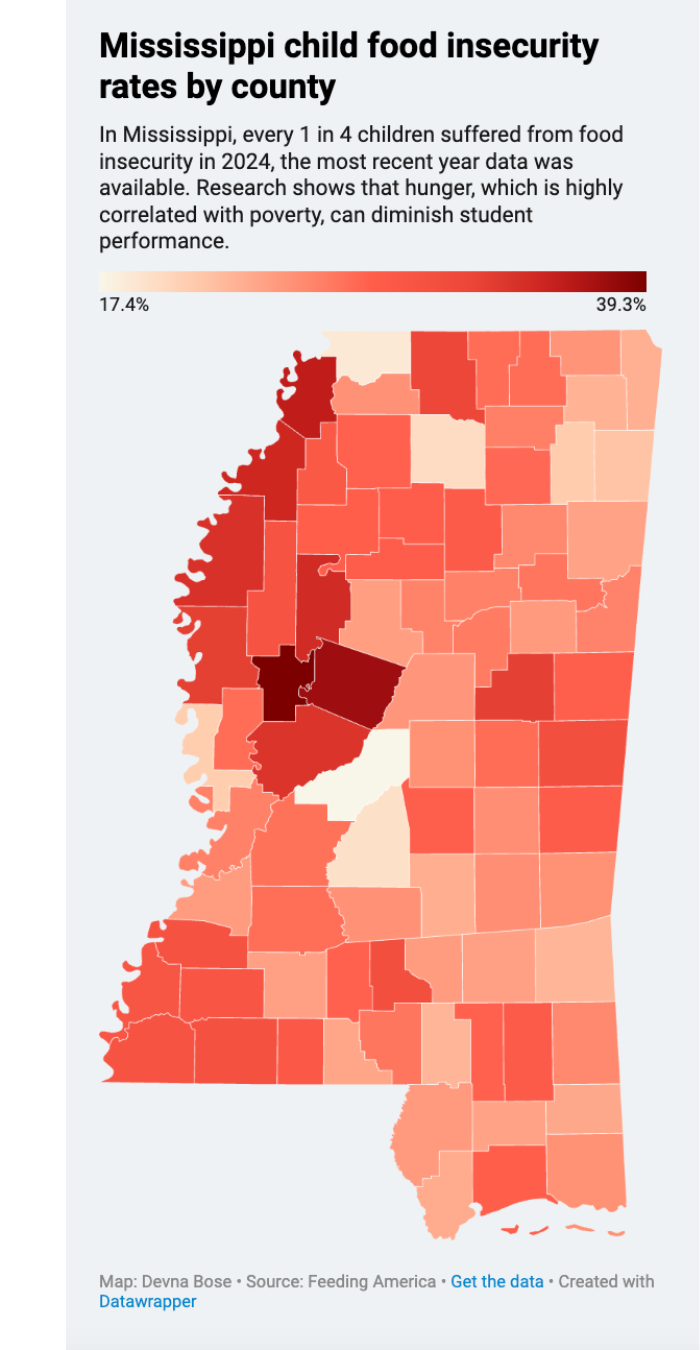
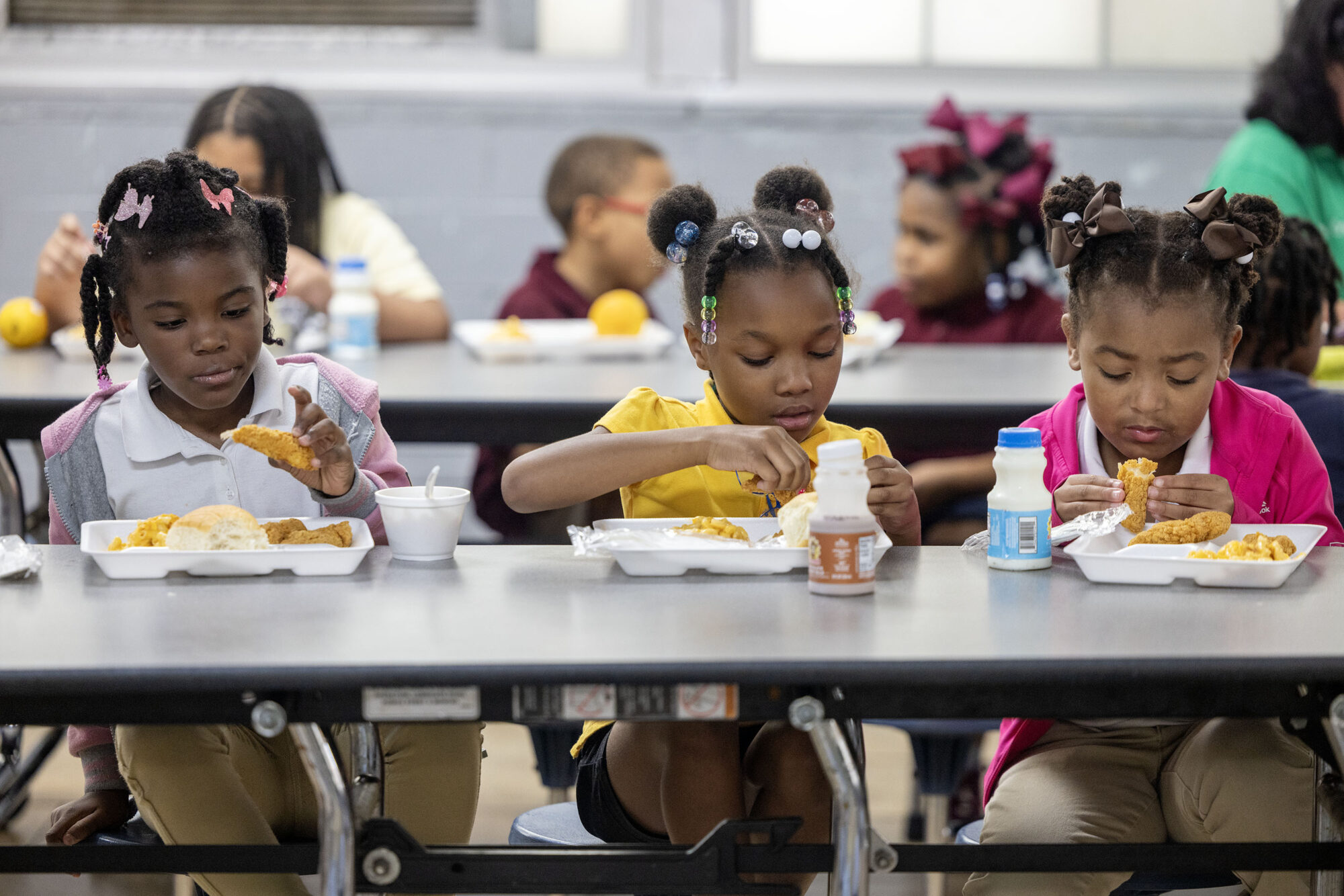
Mississippi Today reporter Devna Bose focused on another essential role: schools as a safety net for families. In Jefferson County, where one in three children experience food insecurity, school meals are a critical source of nourishment. The district also provides childcare and transportation, and teachers and administrators routinely step in to help families navigate needs that have little to do with the classroom. The district is the county’s largest employer.
The story’s central tension is one many rural communities are facing: Jefferson County schools have lost nearly 20% of their students over the past decade, and consolidation is being discussed. But closing or merging schools can mean more than changing a district map. As Superintendent Adrian Hammitte put it, many communities rely on the school district as “the heart of the community.”
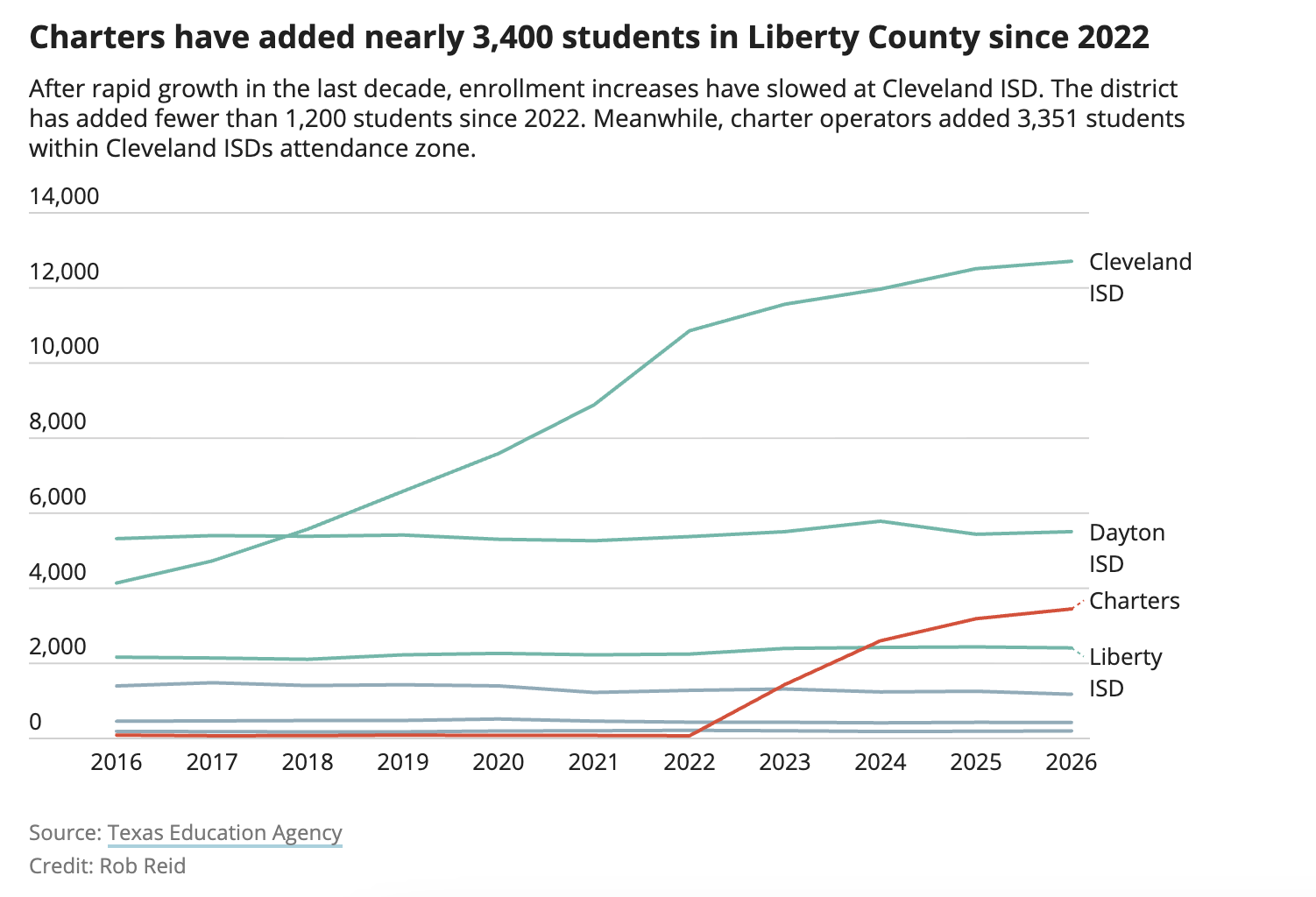
The Texas Tribune examined a very different rural-school challenge: communities that are growing faster than their traditional public schools can accommodate them. In Liberty County, rapid population growth has fueled a sharp increase in charter-school enrollment as Cleveland ISD struggles to expand facilities, staff and programs under a funding system that can leave districts waiting for money even as new students arrive. Rural districts across Texas have added 13% more students since 2021, while urban districts have lost nearly 90,000 students. Charters, meanwhile, have been able to respond more quickly to growth, opening new campuses and offering specialized programs as traditional districts grapple with construction costs, staffing shortages and limits on local funding.
The story also captures the bind that can follow a period of rapid growth. Districts may have to build schools, hire staff and add buses for a surge in students, only to find enrollment leveling off before the new infrastructure is paid for. And while charter schools can provide families with additional options, their growth can further strain traditional districts by drawing away students — and the funding that follows them. The result is a complicated question for rural communities: how should schools be funded and planned for across the entire cycle of growth, stabilization and decline?
And perhaps one of the most meaningful parts of this collaboration is who is doing this reporting. They’re journalists who live there, raise families there, know the school officials and community leaders and understand the stakes because they are part of the places they’re covering.
That local connection is particularly powerful in rural communities, where the reporter may also be a parent at the school, a neighbor of the superintendent, a volunteer, a youth-sports parent or simply someone who has watched the community change over time.
Bushatz is one example. Her own children use a school building for a youth group, and that personal experience helped lead her to a reporting question that the available data couldn’t answer.
For these newsrooms, the collaboration isn’t replacing that local knowledge. It’s giving them additional tools to dig deeper into questions they are already uniquely positioned to see.
The data analysis from Big Local News is one of those tools. So is the ability to compare what is happening in one rural community with what is happening hundreds or thousands of miles away. A school closure in Alaska may look very different from one in Minnesota or Mississippi, but the underlying questions — about enrollment, funding, identity, services and community resilience — can be remarkably similar.
And the benefits aren’t limited to a single story.
Bushatz said the audience-experiment funding attached to the project is allowing Mat-Su Sentinel to try social video, something the newsroom had been avoiding because of the cost and capacity required to produce it. The newsroom is also using some of the funding to build an in-house stock photo library it can draw from for years to come.
But she said the biggest benefit may be mentorship, both from Big Local and audience consultants like Phillip Smith who are helping members experiment with audience strategies.
“Because I am such a small operation, I view every mentor pairing as adding to my staff,” Bushatz said. “I don’t have an audience lead or expert on staff, but I have Phillip telling me what to do.”
For a small newsroom, that kind of expertise can be transformative. It is one of the reasons we build collaborations like this: not simply to produce more journalism, but to give rural newsrooms access to data, expertise, resources and one another that they might not otherwise have.
The first round of “Common Ground” shows there is no single definition of what a rural school means to its community. Sometimes it is the building. Sometimes it is the people. Sometimes it is the food on the cafeteria tray, the basketball court, the polling place, the after-school program or the Friday night crowd.
Often, it’s all of those things at once.
And as rural communities navigate declining enrollment, rapid growth, consolidation and changing models of public education, understanding that full role will matter — not just for the students who attend these schools, but for the communities built around them.
The reporting continues. Four rounds of stories will ultimately explore the role and future of rural schools across the country, with the next round – set to publish in December – taking a different look at the data and questions emerging from these communities.
Read the stories
BenitoLink: Rural schools: Valued community anchors in remote locations
KAXE: When rural districts combine, wins for budgets and students come with identity loss
Oxford Free Press: Butler County schools offer more than just education
Mat-Su Sentinel: In Mat-Su, neighborhood schools double as community hubs. Closing them has sweeping impacts.
Mississippi Today: ‘The heart of the community’: Jefferson County schools provide more than an education
The Texas Tribune: As Texas’ rural school districts struggle with growth, charter schools fill the void — forthcoming